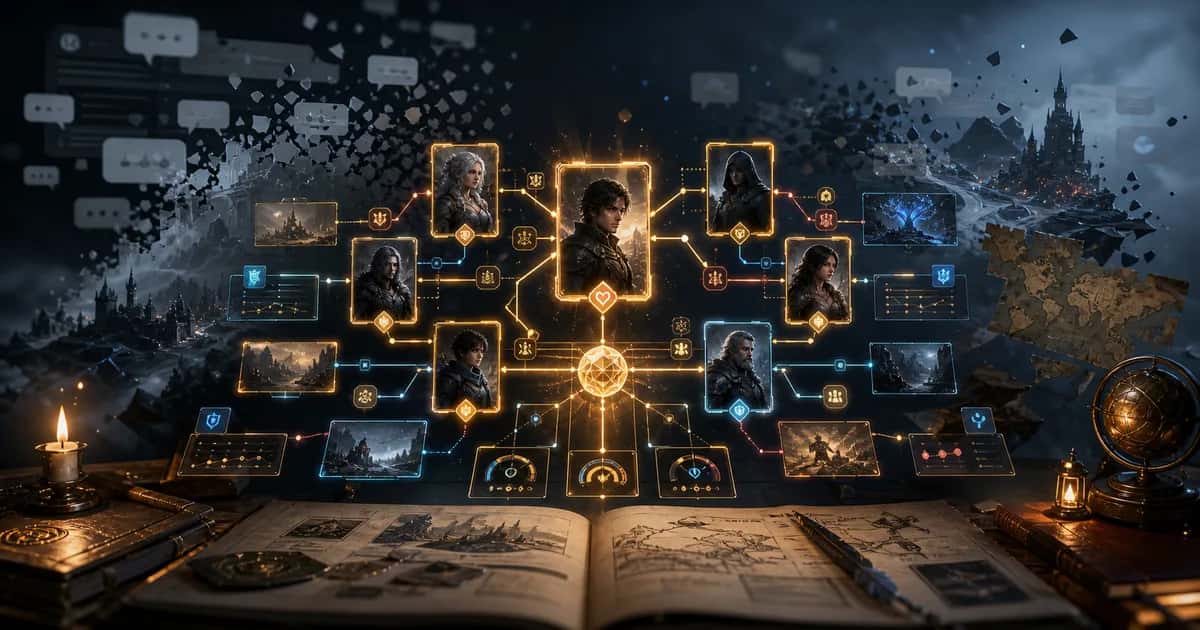
You lie to a guard, rescue a rival, promise a favor, and leave the scene with a wound that should affect the next fight. Ten minutes later, the game introduces the guard again and your rival has forgotten the rescue. The prose may still be convincing, but the RPG is no longer tracking your campaign.
A persistent AI RPG needs more than a long transcript. It needs durable world state, selective character memory, relationship continuity, and rules for deciding which consequences should change a later scene. Without that layer, every session slowly drifts back toward its starting point.
What persistent AI RPG memory actually does
Persistent AI RPG memory preserves consequences that should affect future play. The model still has a limited context window, so the game must decide which facts are current, who knows them, and when they matter. If an important event is missing, buried, or summarized badly, the next scene will drift.
One practical pattern is story first, reconcile second. The first AI call writes the scene players read. A separate continuity pass then records the consequences that survived the scene. In aiga_, memory connects to relationships, metrics, milestones, and world state instead of sitting in a loose note above the prompt.
- Chat history remembers wording. Story state remembers consequences.
- Pinned notes, summaries, and long context help, but none of them automatically know what is still true.
- A useful AI RPG with memory gives relationships, wounds, promises, clues, faction changes, and measurable state a durable place to live.
Why AI RPGs lose track of a campaign
Most AI roleplay products begin with a simple loop: user message in, model response out. It works for a short scene. A campaign is harder because recurring NPCs, hidden motives, public consequences, and unfinished objectives all have to survive beyond the current exchange.
The difficult part is not storing text. The difficult part is knowing what the text means. A joke, a wound, a confession, a betrayal, a travel route, a clue, and a relationship shift can all appear in the same transcript. Some are flavor. Some are canon. Some are active state. Some should be remembered privately by one character and never exposed to the player until the fiction earns it.
If the app saves everything, future prompts become noisy. If it saves too little, the story loses causality. That is why AI roleplay memory has to be more selective than a chat log.
- Long transcripts push important facts out of active context.
- Auto-summaries can flatten cause and effect into vague recap.
- Character cards often describe the starting point, not what changed during play.
- Relationship changes are easy to overstate after one nice message or ignore after a major betrayal.
A larger context window is not persistent RPG memory
A larger context window can help an AI chatbot with memory, but it does not solve story continuity by itself. More text means the model can inspect more material. It does not mean the product has decided what is true, current, resolved, private, public, or important.
Good roleplay memory is selective. It should keep the fact that a guard now distrusts the hero after seeing a forged pass. It should ignore ordinary small talk that has no future consequence. It should also know the difference between "this happened in history" and "this is still active state."
| Storage | What it is good at | Where it breaks |
|---|---|---|
| Raw chat | Exact wording and recent scene texture | Too much noise for long AI roleplay campaigns |
| Summary | Compact recap of broad events | Can blur motive, ownership, privacy, and cause |
| Pinned memory | Important facts the user manually marks | Depends on the player knowing what to preserve |
| World state | Current truth: relationships, metrics, locations, status | Needs product design, not just a longer prompt |
How persistent AI RPG state gets updated
There is a real design tension in AI roleplay. If the first model call is asked to write beautiful prose, run the scene, change stats, judge relationships, update memories, award milestones, manage objectives, and keep every ledger clean, every responsibility competes with every other responsibility.
aiga_ takes a more focused product shape. The first call is there to make the player-facing story feel alive: scene, choice, reaction, voice, danger, surprise, and momentum. After the scene is committed, a continuity layer can inspect what actually happened and update the durable consequences that should affect later play.
That timing matters. "I swing at the captain" is not the same as "the captain is wounded and hates me forever." The story needs to resolve whether the attack landed, who saw it, how severe it was, and whether it changed anyone's future behavior. Only then should AI story continuity move memory, relationships, or metrics.
- The story pass protects pacing and creativity.
- The reconciliation pass protects continuity and consequence.
- The game can keep secrets, private suspicions, public facts, and player-known history from collapsing into one generic recap.
What an AI RPG should remember separately
In a living RPG story, memory is not one bucket. A relationship change is different from a health change. A faction reputation shift is different from a private suspicion. A clue is different from a promise. A wound that still limits a character is different from a dramatic line that only mattered in the moment.
That is why aiga_ talks about story continuity through several product concepts. The player should not need to think about these systems, but the world feels better when each one has a clear job.
| System | Question it answers | Player-facing effect |
|---|---|---|
| Memory | What consequence should this character carry forward? | NPCs remember betrayals, debts, secrets, wounds, and changed beliefs. |
| Relationships | Who trusts, fears, owes, suspects, loves, resents, or follows whom? | Social progress feels earned instead of flipping after one nice line. |
| Metrics | What measurable condition changed? | Reputation, danger, morale, health, and resources can matter later. |
| World state | Where are people, what is active, and what has been discovered? | The next scene starts from the world you actually changed. |
How aiga_ handles persistent AI RPG worlds
aiga_ is not built like a single character bot trying to roleplay forever from a shrinking pile of chat. It is built around playable worlds: characters, factions, locations, illustrated scenes, choices, chat, history, and multiplayer sessions that all belong to the same story space.
That makes the memory problem more tractable. Instead of asking one prompt to remember everything by vibe, the product can treat consequences as part of the world. A companion can remember a betrayal. A faction can react to reputation. A metric can move because of a resolved event. A future scene can pull in the relevant continuity without flooding the model with every line you ever typed.
The result is the difference between "the bot remembers a few notes about you" and "the world has a record of what changed." For long-form AI RP chat, AI RPG story generation, AI adventure generation, and Discord roleplay, that difference becomes obvious fast.
- Use AI RP chat when you want character conversations connected to the wider story.
- Use AI RPG story generator when you want a playable campaign world, not only a prompt.
- Use AI adventure generator when you want illustrated scenes and choices.
How to choose a persistent AI RPG
When an app says it has memory, ask what kind of memory it means. A pinned note, a longer context window, a lorebook, a summary, and a persistent world model are not interchangeable. The right question is not "does it remember?" It is "does it know what should still matter?"
- Choose aiga_ if you want persistent story worlds, illustrated scenes, multiplayer flow, and continuity across chat, choices, relationships, metrics, and memories.
- Choose a character-chat app if you mainly want intimate one-on-one dialogue and can tolerate manual reminders when the bot drifts.
- Choose a writing tool if you want prose control, lorebooks, and drafting rather than playable game state.
- Choose a DIY ChatGPT, Claude, or Gemini workflow if you are happy to manage summaries, canon notes, and continuity yourself.
- For campaign-style play, also compare AI Dungeon Master tools and AI Dungeon alternatives.
FAQ
Why do AI RPGs forget important campaign details?
They usually forget because the important detail is not in the active context, was summarized too vaguely, or was never saved as durable story state. The model can only use the information the product retrieves and presents for the next scene.
Is a bigger context window enough for persistent AI RPG memory?
No. Bigger context helps, but roleplay continuity still needs selection, retrieval, and state. The app has to know which facts are current, resolved, private, public, and relevant to the scene.
How does aiga_ keep AI stories coherent?
At a product level, aiga_ separates the story moment from the continuity work that follows it. The story can stay creative, while durable consequences such as memories, relationships, metrics, milestones, and world state can be reconciled for future play.
Does aiga_ expose all of this as technical settings?
No. The point is to make continuity feel natural to players and creators. You should feel that characters remember, worlds react, and choices matter without needing to manage a technical prompt stack.
Persistent worlds need more than longer chat logs
Memory earns its keep when it changes play. If the game forgets a betrayal, a wound, or a debt, the player learns that choices are temporary decoration. The campaign may continue, but it no longer feels causal.
Longer chat logs help with recent wording. Persistent playable worlds go further by carrying forward the state that survived the scene. That is the useful test for an AI RPG: does it remember what changed, or only what was typed?
See how that continuity works in a campaign built for one player on the solo AI RPG page.
- For character-app comparisons, read Best Character.AI Alternatives for Roleplay in 2026.
- For campaign tools, read Best AI Dungeon Master Tools in 2026.
- For world creation, read How to Build a Playable AI RPG World.
Play a persistent AI RPG world
Create an illustrated RPG world, talk to its characters, invite other players, and see earlier choices return in later scenes.
Start playing