The innkeeper remembers your name but forgets the debt. The sword you sold appears in your pack again. A rival who died three scenes ago walks into the next room. AI can produce convincing fantasy prose quickly. Keeping a game coherent is the harder job.
The best AI fantasy RPG for you depends on what sits beneath the narration: free-form input, tracked quests, visible dice, persistent world state, multiplayer tools, images, or a carefully authored setting. This guide compares nine public products by those documented differences, so you can narrow the field before spending money or committing to a campaign.
Quick answer
Start with the kind of fantasy game you want. AI Dungeon offers the loosest text sandbox. Friends & Fables and AI Realm document the clearest D&D 5e-inspired structures. NOPOTIONS puts visible d20 checks inside one handcrafted dark-fantasy world. SagaBound emphasizes tracked game state in a browser.
For campaign play that moves between structured story events and open character chat, aiga_ keeps both inside the same persistent world. Optional scene art and lightweight mechanics add presentation and structure without replacing that core loop. FableAI focuses on mobile presentation, voice, and co-op, while AI Tales offers a lighter mobile loop with dice and cards. Old Greg's Tavern is shaped around casual solo or group dungeon campaigns.
- Best for an open-ended fantasy sandbox: AI Dungeon.
- Best documented 5e-style group structure: Friends & Fables.
- Best for a handcrafted dark-fantasy setting: NOPOTIONS.
- Best for visible browser game state: SagaBound.
- Best for structured story events plus open character chat: aiga_.
- Best for voice-led mobile presentation: FableAI.
Nine AI fantasy RPGs at a glance
This table is a first filter, not a scorecard. "Free entry" means that the product documents a way to begin without paying. It does not mean long campaigns are free. Prices and allowances were checked on August 23, 2026.
| Platform | Best for | Free entry | Rules style | Play |
|---|---|---|---|---|
| aiga_ | Events + open chat | 4 turns + chat | Story-first | Solo or group |
| Friends & Fables | 5e-style parties | 25 turns daily | D&D-inspired | Solo or group |
| AI Dungeon | Open text sandbox | Yes | Free-form | Solo or group |
| NOPOTIONS | Dark fantasy | Daily credits | Visible d20 | Solo |
| SagaBound | Tracked game state | 50 turns daily | Structured | Solo |
| AI Realm | 5e-style creation | Free plan | D&D-inspired | Solo |
| AI Tales | Mobile sessions | Yes | Dice and cards | Solo |
| FableAI | Voice and art | Free plan | Free-form | Solo or co-op |
| Old Greg's Tavern | Casual campaigns | First hour | Light rules | Solo or group |
What counts as an AI fantasy RPG?
For this comparison, an AI fantasy RPG must let the public start a repeatable game or campaign, respond to player actions, run characters and conflicts, and carry enough information forward for earlier choices to affect later turns. Fantasy also has to be a core use case, not one costume available to a general companion chatbot.
That leaves out character chat apps, conventional games that use AI only for isolated NPC dialogue, and writing tools that produce prose without a game loop. NovelAI, for example, has a text-adventure mode and strong writing controls, but its main product is a fiction studio. General assistants such as ChatGPT can run a homemade session, but the player supplies the rules, state tracking, and continuity discipline.
- The player can choose or type actions that change what happens next.
- The product supports an ongoing loop rather than one generated story.
- Fantasy worlds, characters, or campaigns are central to the product.
- Current access and product details are available from first-party sources.
How this comparison was assembled
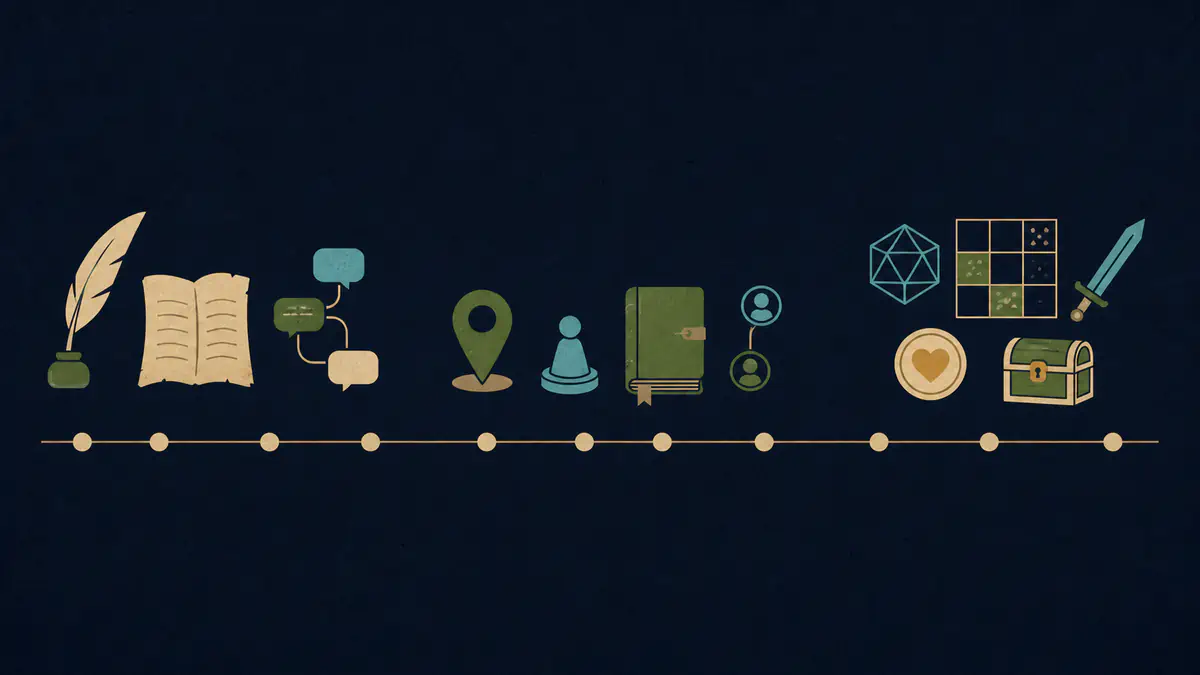
This comparison uses current product documentation, pricing pages, help centres, and public store listings, all checked on August 23, 2026. Each profile asks the same questions about fantasy fit, player input, continuity, rules, presentation, social play, cost, and product status.
A plain statement from a first-party source is treated as documented. Claims about memory quality or player scale are attributed to the developer. When a public page does not give an answer, the profile says so instead of filling the gap. The spectrum above runs from free-form storytelling toward explicit game systems. It describes product design, not quality.
aiga_ publishes this article and is one of the products compared. Its profile uses the same public-facing product and pricing information as the other entries. Competitor links are direct product links, not affiliate or referral URLs, and no product paid for placement.
The best AI fantasy RPGs in 2026
The order below follows product shape, from broader story-first platforms toward more explicit fantasy systems. It is not a numerical ranking. Six entries have not appeared in earlier aiga_ comparison articles.
aiga_: persistent worlds with open character chat
aiga_ is built for players who want a fantasy world with a game rhythm rather than a blank chat. You can create a world or enter a Shared World, make a hero, then move through story events with suggested choices or your own actions. Character chat, locations, factions, lightweight traits, and optional scene art sit inside the same campaign context.
The public product pages describe world and session state tied to characters, locations, factions, and story history. That is a documented design, not a promise of perfect recall. aiga_ is narrative-first and does not reproduce D&D classes, spell slots, or 5e combat. Free accounts receive four story turns per day, plus several conversational character or GM chat messages between story events. When a chat becomes a significant action that advances the game, it uses a turn. Paid plans remove the daily text limit, while optional images and heavier generation use credits.
- Good fit: solo or shared campaigns that move between structured story events and open character interaction.
- Look elsewhere if: you want strict tabletop rules, tactical maps, or guaranteed recall of every detail.
- Related guides: create a playable RPG world, explore solo AI RPG play, or see how images change interactive fiction.
Friends & Fables: D&D-inspired party campaigns
Friends & Fables is the clearest fit here for a small group that wants D&D-inspired sheets, maps, tactical combat, world-building tools, and an AI game master called Franz. Its pricing page documents campaigns for three players on Free, rising to six on Legend, while invited friends can join without their own subscription.
The company lists long-term memories on every plan, but that is a developer description of the feature rather than a comparative measure of recall. Free provides up to 25 turns per day. Paid monthly plans run from $19.95 USD for Starter to $39.95 USD for Legend. Friends & Fables labels itself an early access beta and warns about bugs, incomplete features, and breaking changes.
- Good fit: groups seeking the most documented tabletop-shaped campaign flow in this list.
- Look elsewhere if: you prefer rules-light free-form fiction or want to avoid beta software.
- Closer comparison: aiga_ versus Friends & Fables and the AI Dungeon Master tools guide.
AI Dungeon: the open-ended text sandbox
AI Dungeon remains the broadest free-form option in this group. Scenarios, Worlds, Story Cards, Plot Essentials, editing tools, and open Do, Say, Story, and See actions give the player more direct control over the transcript than most purpose-built RPG interfaces. Fantasy is one of many supported genres rather than a fixed setting.
AI Dungeon documents a Memory System made from Auto Summarization and a Memory Bank. It also explains the constraint clearly: each model and membership has a finite context window, and older material may be summarized or retrieved rather than kept verbatim. The free Wanderer tier stores 25 memories. Paid memberships start at $14.99 USD per month and scale to larger context, memory allowances, models, and image credits.
- Good fit: players who value prompt freedom, editing, community scenarios, and a classic text-adventure loop.
- Look elsewhere if: you want authoritative inventory, quest, and combat state enforced outside the narration.
- See the detailed AI Dungeon alternative comparison for the product boundary.
NOPOTIONS: one handcrafted dark-fantasy world
NOPOTIONS takes a narrower and more game-like route. Every player enters Valdaria, a shared authored dark-fantasy setting with its own calendar, map, classes, skills, inventory, progression, relationships, quests, and persistent journal. Risky actions use visible d20 checks with a displayed difficulty class and modifiers.
Its current release is labelled early access. The class roster and parts of the world are still expanding, which makes it less suitable if you want to generate any setting on demand. Players can claim up to 10 free credits daily. Flask and Elixir narration cost one credit per turn, and one-time packs range from $3.49 USD for 100 credits to $19.99 USD for 700.
- Good fit: solo players who want a defined dark-fantasy world and dice results they can see.
- Look elsewhere if: custom world creation or a large starting class roster matters more than authored continuity.
- Documented continuity: the journal, world calendar, relationships, locations, and stored progression form the persistent layer.
SagaBound: browser RPG state that stays visible
SagaBound describes itself as an AI dungeon master with quests, combat, inventory, HP, NPC reputation, codex entries, and persistent story state. Its official FableBound world covers epic fantasy, while the World Forge lets players create and publish settings with lore, factions, characters, and rules. It runs in a browser on desktop, phone, and tablet.
The developer says the system saves complete game state after every turn and can retrieve older moments through searchable long-term memory. That is a developer claim, not an independent measure of recall. Free includes 50 story turns per day and a 12k context window. Paid plans begin at $8.99 USD per month, with larger context and image-credit allowances on higher tiers. Unlimited paid turns are subject to fair-use safeguards.
- Good fit: players who want browser access and visible quests, inventory, combat, and progression.
- Look elsewhere if: you want a long-established platform with years of public release history.
- Status note: SagaBound is a newer entrant, so its documented systems are clearer than its long-term operating record.
AI Realm: detailed 5e-inspired campaign setup
AI Realm is built around D&D 5e-inspired adventures, with character creation, combat modes, spells, campaign summaries, NPC cards, GM guides, model selection, and image generation. Its V2 guide documents separate stored character and guide data, plus controls for deciding which material enters the active model context.
That manual context approach is unusually transparent, but it also asks the player to manage enabled NPCs and guides. AI Realm says V2 is live while acknowledging current issues on its public site. A free plan is documented, alongside Bronze, Platinum, Emerald, and Obsidian limits, but a public page with current USD plan prices was not available during the August 23 check.
- Good fit: players who want familiar 5e-style building blocks and granular campaign context controls.
- Look elsewhere if: you want pricing clarity before creating an account or prefer a lower-maintenance story flow.
- Documented limitation: enabled NPCs and GM guides share finite context, so the guide recommends rotating relevant material.
AI Tales: light mobile fantasy play with dice and cards
AI Tales is a single-player mobile AI fantasy RPG for Android and Windows. The Google Play listing documents typed actions, ready-made or custom worlds, dice rolls, card flips, rewinds, and generated images. It is closer to a casual interactive story app than a tabletop campaign manager.
The same store listing shows more than 100,000 downloads and a July 4, 2026 update. Those are store statistics, not evidence of quality. The app is free to start, contains in-app purchases, and offers a Game Master upgrade, but the listing does not publish a clear plan or turn-cost table. Its claims that characters remember and every choice matters are developer claims.
- Good fit: Android players who want short fantasy sessions with visible dice and card interactions.
- Look elsewhere if: you need transparent ongoing costs, party play, or documented campaign-state mechanics.
- Platform note: no separate public web game or verified iOS listing was used for this comparison.
FableAI: mobile presentation, voice, and co-op
FableAI combines a free-form AI text RPG with voice narration, generated art, music, mobile apps, browser access, and real-time co-op. Players can choose from published adventures or start a world from a sentence. That makes it a useful option when presentation matters more than visible tactical systems.
FableAI says its smart memory tracks choices, characters, and consequences across chapters. This is a developer-reported claim. The site also reports more than 100,000 players and 5,000 adventures, figures that are not independently verified here. A forever-free plan is documented, with optional subscriptions and gem packs, but the public plans page does not present a stable, concise price table suitable for a direct cost-per-turn comparison.
- Good fit: mobile-first players who want narration, art, notifications, and casual co-op.
- Look elsewhere if: visible dice, tactical state, or predictable per-session cost is the priority.
- Cost caution: model and narration choices can use different gem amounts, so check the in-product rate before committing.
Old Greg's Tavern: informal solo and group dungeon campaigns
Old Greg's Tavern is an original fantasy role-playing platform with AI narration, character creation, persistent campaigns, solo play, and groups of up to six people. Its tone is deliberately irreverent, which is a genuine point of difference if you want a relaxed dungeon game rather than a solemn epic or tactical virtual tabletop.
The first hour is free. After that, the published options are $5 USD for 50 rounds, $15 USD per month for 200 rounds, or $25 USD per month for 450 rounds. Invited players can join a host's game without buying their own rounds. The terms state that AI-generated output is licensed for personal, non-commercial use, so creators planning to reuse campaign material should read those terms first.
- Good fit: friends who want an approachable campaign host with a specific comic voice.
- Look elsewhere if: commercial ownership of generated material or precise 5e adjudication is important.
- Cost note: the unit is a round, so compare the included round count rather than the headline subscription alone.
Which AI fantasy RPG fits your style?
A useful shortlist starts with the interaction you care about most. These recommendations point to a documented product shape, not a universal winner.
- Open-ended fantasy sandbox: AI Dungeon, because its Do, Say, Story, editing, and scenario tools preserve the broadest input surface here.
- Structured events with open character chat: aiga_, because both forms of play share the same persistent characters, locations, factions, and campaign context.
- Tactical D&D-style group campaign: Friends & Fables, because it documents party limits, maps, character sheets, and D&D-inspired combat.
- Handcrafted dark-fantasy world: NOPOTIONS, because Valdaria, visible d20 checks, and persistent journals are the core product rather than optional templates.
- Browser game with visible state: SagaBound, because HP, inventory, quests, combat, and codex data are explicit parts of the interface.
- Mobile fantasy adventure: AI Tales, because its current store listing supports Android and Windows with short single-player sessions.
- Strong presentation and voice: FableAI, because it documents voice narration, generated art, music, and mobile apps.
- Casual campaign with friends: Old Greg's Tavern, because a host can invite up to five friends and the game uses a clear round allowance.
- Free entry: begin with AI Dungeon for free-form text, SagaBound for 50 tracked turns daily, or aiga_ solo play for four daily story turns plus conversational chat between events.
What these products still cannot promise
A memory feature does not remove the model's context limit. AI Dungeon documents summaries, retrieval, and finite Memory Bank slots. AI Realm tells players to enable only the NPCs and guides relevant to the current scene. aiga_ stores structured world and session state, but generated narration can still miss or reinterpret a detail. These are different methods of deciding what reaches the next response, not guarantees that every fact will survive forever.
Free allowances also describe an entry point, not the cost of a long campaign. Images, stronger models, narration, larger context, or extra turns may use credits, gems, subscriptions, or purchased rounds. Beta labels matter too. Friends & Fables and NOPOTIONS explicitly describe themselves as early access, while AI Realm acknowledges current V2 issues.
Features and prices change quickly in this category, and several claims about memory cannot be checked from public documentation alone. Use this comparison to build a shortlist, then try the free entry of the two products that fit your style before trusting any best-of list, including this one.
- Text memory can summarize or retrieve history without enforcing authoritative game state.
- Structured stats can remain consistent while generated dialogue still gets a detail wrong.
- Optional images add cost and generation time; text-only play can be the better choice.
- A beta can change rules, prices, and saved-data behaviour between updates.
- For a deeper explanation, read why AI roleplay apps forget your story.
Frequently asked questions
What is an AI fantasy RPG?
An AI fantasy RPG is a repeatable role-playing game in which generated narration reacts to your actions while the product carries some campaign information forward. Products vary widely: AI Dungeon is a free-form story sandbox, while NOPOTIONS and SagaBound document explicit dice, quests, inventory, or progression systems.
What is the best free AI fantasy RPG?
AI Dungeon is the clearest free choice for open-ended text play. SagaBound documents 50 free turns per day, Friends & Fables offers 25, and NOPOTIONS provides daily credits. aiga_ includes four daily story turns plus conversational character or GM chat between events; a chat that significantly advances the game uses a turn.
Which AI fantasy RPG is best for solo play?
Choose by structure. AI Dungeon suits a loose solo sandbox, NOPOTIONS suits a mechanically visible dark-fantasy world, and aiga_ suits a persistent world that moves between structured events and open character chat. The solo AI RPG guide explains how a narrative-first campaign differs from a strict tabletop rules engine.
Can I play an AI fantasy RPG with friends?
Yes. Friends & Fables documents campaigns for three to six players depending on plan. Old Greg's Tavern supports a host plus five invited friends. FableAI offers real-time co-op, AI Dungeon supports multiplayer adventures, and aiga_ supports private or community games. Check whether the host, every player, or the shared session pays.
Which AI fantasy RPGs document a real memory system?
AI Dungeon publishes the clearest technical explanation, covering Auto Summarization, the Memory Bank, and finite context. SagaBound describes saved story state and searchable long-term memory, while FableAI calls its system smart memory. Those latter descriptions are developer claims. aiga_ documents structured world and session state rather than promising perfect recall.
Are AI fantasy RPGs the same as D&D?
No. Friends & Fables and AI Realm explicitly use D&D or 5e-inspired structures, and NOPOTIONS uses familiar d20 checks, but each product has its own implementation. AI Dungeon, FableAI, and aiga_ are more narrative-first. If exact action economy, class rules, spell wording, or tactical adjudication matters, verify the product's rules documentation before subscribing.
The two to open first
For a free-form fantasy sandbox, open AI Dungeon and compare its editing and Memory System with one more structured choice. Pick Friends & Fables for a D&D-inspired group, NOPOTIONS for one authored dark-fantasy world, or SagaBound for visible browser state.
For a persistent world that moves between story events and open character chat, open aiga_ alongside FableAI if mobile voice matters, or Old Greg's Tavern if you are bringing friends. AI Tales makes more sense for brief mobile sessions; AI Realm is for players willing to manage a detailed 5e-style campaign setup. Try the free entry of your two closest fits before paying.
- Want to build the setting yourself? Start with the AI RPG story generator.
- Want looser choices and open actions? See the AI adventure generator.
- Want to understand campaign design first? Read how to create a playable AI story world.
Create a fantasy world you can play
Start with a premise, create a hero, and turn the world into a narrative-first RPG with choices, character chat, and optional scene art.
Create an AI RPG