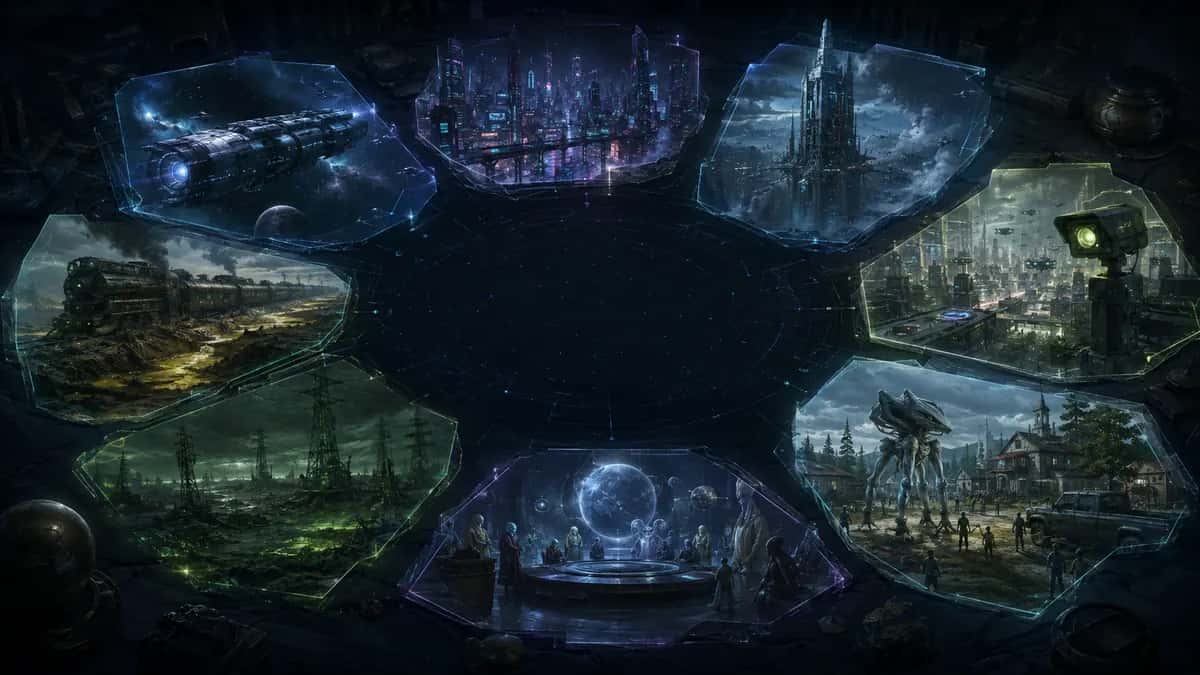
Sci-fi prompts often arrive buried under their own scenery. The starship has six decks, the city has synthetic weather, the memory implant has a fictional patent number, and none of it gives the player a reason to act. A useful prompt follows one strange idea until somebody benefits and somebody else gets stuck with the bill. Then it gives the player a reason to interfere.
These eight campaign seeds begin where those questions become urgent. You get a role to inhabit, other people already pursuing their own plans, and a first decision with no clean answer. Use them for a solo AI RPG, bring them to a group, or turn one into a setting with the AI RPG generator.
Each entry also points to a public aiga_ Shared World with a similar mood or style of play. It is not a playable edition of the prompt and does not share its names or lore. Open the world if you want to begin playing, or pull the prompt apart and make something else from it.
What should a sci-fi RPG prompt include?
An unusual invention is only a start. Show how it has changed an ordinary part of life, then put the player where its benefits and damage meet. Skip the encyclopedia. Give the first choice some pressure and leave enough unfinished business to cause trouble ten scenes later.
- A specific player role with access, responsibility, or a problem nobody else shares.
- One speculative change that alters ordinary life in the setting.
- A limit or cost that prevents the technology from fixing everything.
- At least two people or factions that want incompatible outcomes.
- An immediate event that brings the conflict to the player.
- Several credible first actions, including room to attempt something unexpected.
What makes a science-fiction premise playable?
A piece of technology becomes interesting once people have built rent, work, law, and family life around it. Cheap memory editing sounds remarkable until a landlord accepts childhood memories as payment. A colony ship sounds heroic until the people born aboard decide they owe nothing to the destination chosen by their ancestors. That is where players find something to argue with.
Before adding another planet or gadget, test the premise with five questions:
- What changed? Name the invention, discovery, disaster, or social rule in one sentence.
- Who gained power? Give control of the change to a person or institution that can make demands.
- Who bears the cost? Put a face on the people who lose safety, freedom, memory, status, or time.
- Why is the player involved? Give the hero access or responsibility that prevents them from watching at a distance.
- What must be decided now? Start when delay becomes a choice with consequences of its own.
How to use these sci-fi RPG prompts
Treat each entry as something to tamper with. Keep the conflict and swap the hero, the technology, the scale, or the tone. Try moving the same dilemma from a starship to a submerged city. If it survives the move, the decision is carrying the premise instead of the scenery.
On aiga_, a prompt can seed a story world with its own cast, factions, locations, progression, and persistent state. The generated opening will interpret the material rather than reproduce every sentence. If one of the related worlds already has the mood you want, start there instead.
- For a short adventure, reduce the map and put the deadline within a few hours.
- For a longer campaign, track something that changes slowly, such as trust, oxygen, public status, system access, or a ship's remaining fuel.
- For solo play, connect one faction to the hero personally so the central conflict cannot become abstract.
- For group play, tie different heroes to different sides. Starting with some disagreement gives the party more to negotiate.
- Do not explain every mystery before play. Decide what is true, what each faction believes, and what evidence the players can actually reach.
8 science-fiction RPG prompts ready to adapt
Each opening is ready to use, but the ending is deliberately missing. Change the names. Merge two factions. Cut the clever technology if the human problem works without it. The Shared World beneath each prompt gives you somewhere to play in a similar corner of science fiction, not a copy of the same setting.
The Colony Ship That Voted to Turn Back Generation-ship survival
Campaign prompt: The generation ship Pilgrim's Wake has travelled for 214 years toward a planet no living passenger has seen. You are the ship's interim continuity officer, responsible for settling disputes between the founding charter and the people born aboard. Three days ago an engine accident killed the senior command crew and left you holding an office nobody expected you to use.
Then a narrow transmission arrives from the destination itself. The atmosphere collapsed decades ago, and the colony beacon has been repeating an automated welcome into a dead sky. Turning home would take another 187 years and consume the reserve intended for final deceleration. Continuing may leave the ship with nowhere to land. Captain Sato's last sealed order insists the transmission is fraudulent, yet its authentication marks are genuine.
The Return Committee demands an immediate vote. The Forward Kin insist that people who never knew Earth cannot be ordered back to it. The cryogenic ward claims legal representation for 22,000 embryos registered as citizens by the founders, enough votes to decide the question on their own. Your younger brother lies in that ward after the accident, and its chief physician will keep him alive only while the deceleration reserve remains untouched.
As the public count begins, life support reports deliberate damage inside a command deck sealed since launch. Then the ship announces the result: 50.1 percent to turn back, including thousands of delegated votes cast by people who have not been born.
The harder question is who gets to choose a future that other generations must live through. Earth and the destination may both be bad bets. Whatever waits in the damaged command deck should make the vote messier, not produce a document that tells everybody the correct answer.
- First decision: Certify the vote, suspend it and enter the sealed deck, publish the destination transmission before verifying it, or propose another course while life support deteriorates.
- Why it can sustain a campaign: The ship is a finite political world. Food, repairs, births, archived orders, generational identity, and the distance to either destination give every alliance a practical cost. Even after choosing a direction, the crew must live with who was allowed to decide.
- Make it yours: Let the destination be habitable but already occupied, or make the transmission a plea from a previous colony ship that arrived and chose to disappear.
 Related Shared WorldVoyage to the Centauri@aiga_Generation-ship RPGExplore this world
The City That Rents Your Memories Memory-economy cyberpunk
Campaign prompt: In the tiered city of Orison Vale, memory is accepted as collateral. A week of childhood can cover a late utility bill. A first love can secure a business loan. The wealthy buy experience without spending years acquiring it, while debtors learn to avoid photographs of lives they no longer remember. You are a licensed recovery courier for Mnemosyne Housing, trained to extract only what a contract names and nothing more.
During an eviction in the rain district, a tenant offers no resistance. She asks you to review the memory before taking it. Inside, you see yourself at seven years old, holding her hand beneath a sky full of burning evacuation craft. Officially you were born four years after the Ashfall and have never left the city. Your employer's system marks the scene as premium corporate property and orders immediate deletion from both minds.
A tenants' union wants you to copy it as evidence that thousands of childhoods were repossessed to conceal what caused the disaster. An illegal clinic can return your missing past, although its surgeon admits the process may overwrite skills and relationships you still value. Your supervisor arrives with a warrant, a promotion offer, and a familiar lullaby you cannot place. At the same moment, the tenant's building begins recognizing you as its legal owner.
Do not treat a memory as flawless video. It may be incomplete, tampered with, or shared by people who remember the same day differently. Those disagreements can complicate a discovery without making the evidence worthless.
- First decision: Complete the extraction, copy the memory for the union, enter the illegal clinic, question your supervisor, or use the building's sudden recognition in another way.
- Why it can sustain a campaign: Every recovered memory can restore a relationship while threatening another. Debt records, stolen expertise, manufactured identities, and the market for lived experience create cases that connect to a larger corporate history.
- Make it yours: Make memories a public voting requirement rather than currency, or let the player remember possible futures instead of the past.
 Related Shared WorldEchoes of Elvoria@x_iyaCyberpunk resistance RPGExplore this world
Citizen 404 Vertical-city techno-thriller
Campaign prompt: Polis-9 rises above a toxic cloud layer in 112 stacked districts. Elevators are borders, oxygen is rent, and a person's legal identity decides which floors will open for them. You designed the emergency systems that keep the lower districts breathing. Two years ago, Helix Municipal ordered you to vent District 83 during a chemical fire to protect the corporate levels above. You refused. The district survived, and the city erased your citizenship, employment, medical history, and name.
Since then you have lived between service floors as Citizen 404, unable to open a door or buy clean air. At 03:10 this morning the tower suffered a rolling blackout. Every public screen displayed your old employee portrait and one sentence: ROOT ADMINISTRATOR REQUIRED. Legacy systems now recognize you for seventeen minutes at the top of every hour, and nobody will say who restored your credentials.
The elected council wants the grid restored and promises a legal identity once the crisis ends. Residents of District 83 want the sealed ventilation records opened first. A Helix auditor offers permanent access if you destroy that archive and route power away from the unprofitable lower floors. Someone using your former credentials has already locked six elevators with hundreds of passengers inside. When the next seventeen-minute window begins, the tower opens every door leading upward and seals every door leading home.
Seventeen minutes of access is powerful enough to matter and short enough to hurt. Using it reveals the player's location, and opening one route may leave another district in darkness. Keep the tower's machinery tied to the people living around it so the campaign does not collapse into a string of hacking puzzles.
- First decision: Rescue the trapped passengers, open the ventilation archive, restore power to District 83, bargain with Helix, or spend the access window climbing toward whoever is using your identity.
- Why it can sustain a campaign: Each district has its own resources, loyalties, and version of what happened. Access windows can expand or disappear while the player's public identity changes from saboteur to symbol, administrator, or something the city cannot classify.
- Make it yours: Place the city below an ocean instead of above clouds, or make the erased identity belong to two people who both remember living the same life.
 Related Shared WorldNEXUS-9: The Stack@potato_crispCorporate cyberpunk RPGExplore this world
The Last Unlicensed Emotion Social dystopia
Campaign prompt: After the Quiet Wars, the city of Lumen ended public violence with compulsory emotional regulation. Every citizen wears a pulse implant that softens anger, panic, and grief before those feelings can spread. Happiness is not required, officials like to say, only stability. You are a field examiner for the Office of Public Calm, sent to investigate implants that fail. Yours stopped working eleven days ago, and you have hidden the returning emotions beneath rehearsed smiles.
Tonight you are ordered to close an illegal mourning room beneath a commuter station. Inside, strangers are grieving people the state says never existed. At the center sits your mother, whose death certificate you signed nine years ago and whose face your family was later required to forget. She tells you the implants were never about dangerous feelings. They exist to identify the people who still remember a district erased during the war.
The mourners want your credentials to broadcast their testimony. Your partner waits upstairs with a containment team and believes this raid will finally earn you both citizenship in the garden sector. The implant manufacturer offers a different account: the woman is a constructed memory carrier built to trigger mass psychosis. Then every pulse implant in the station fails at once, and hundreds of commuters begin feeling years of deferred grief on a crowded platform.
Avoid turning emotion into a meter where sadness is bad and happiness is good. People in Lumen have lived through a war, so fear of another outbreak can be sincere even when the state exploits it. Private grief becomes evidence here, and sharing it can endanger the person who trusted you with it.
- First decision: Let the containment team enter, help the mourners broadcast, take your mother for private verification, restore the station's implants, or address the commuters before either side controls the scene.
- Why it can sustain a campaign: Each district can reveal a different bargain between safety and emotional freedom. The player's partner, family, implant status, and public credibility can all change as buried histories return.
- Make it yours: Regulate dreams instead of emotions, or make the implants voluntary but necessary to enter schools, hospitals, and workplaces.
 Related Shared WorldThe Smile Protocol@helixDystopian mystery RPGExplore this world
First Contact on the Night Shift Comic alien crisis
Campaign prompt: At 2:13 a.m., an alien delegation lands in the car park of Bargain Galaxy, the least successful warehouse store in northern England. You are the night supervisor, currently responsible for four employees, a leaking freezer, and 600 promotional garden gnomes nobody ordered. The visitors scan your loyalty card, interpret its gold star as a planetary seal, and address you as Earth's authorized trade representative.
Their offer sounds simple. Humanity may join a prosperous interstellar exchange if you present one item that represents the planet's shared values before sunrise. Unfortunately, every object they scan becomes legally binding evidence about human civilization. A packet of biscuits commits Earth to hospitality law. A security camera suggests permanent surveillance. The garden gnome may constitute a declaration of religious allegiance.
Your exhausted staff cannot agree on what to present, and one of them has begun selling selfies with the delegation. A government crisis unit surrounds the store and orders you to surrender the card, but the aliens refuse to speak with anyone whose customer-service rating is lower than yours. Your missing manager calls from home to demand credit for the contact. With ninety minutes remaining, the inventory system recommends the only product purchased in every country on Earth: bottled water, currently stacked behind the police line.
Keep the jokes anchored to retail work: petty rules, tired staff, useless stock, and a manager calling at the worst possible time. A misunderstanding should leave an obligation behind instead of vanishing after the punchline. The other employees need plans of their own too.
- First decision: Present an object from the store, hand over the loyalty card, promote an employee as Earth's real leader, ask the aliens what they value first, or turn the misunderstanding into a different proposal.
- Why it can sustain a campaign: Even a mundane product can reveal an alien law. The store staff, government negotiators, opportunistic companies, and the delegation will keep disagreeing over who speaks for humanity. A successful first meeting only produces stranger trade disputes.
- Make it yours: Move first contact to a wedding, a roadside repair shop, or a local election count where the aliens mistake ballots for declarations of war.
 Related Shared WorldOffice Drone vs Alien Apocalypse@dynaComic alien-invasion RPGExplore this world
Seven Days of Power Post-collapse civic survival
Campaign prompt: A geomagnetic storm has destroyed the national grid and left the river city of Calder as an island of darkness. You are the dispatcher in its last functioning control room. The underground hydro battery holds seven days of power at the current load, no rescue signal has arrived, and every allocation you approve is recorded with your name beside it.
The hospital needs uninterrupted supply for intensive care. The eastern water plant can prevent disease if its pumps run six hours a day. Glasshouse Ward grows the city's remaining seedlings beneath lamps. The old financial district holds a government data vault that may contain regional restoration plans, while the privately owned Crown Arcology offers armed security in exchange for priority. Every group has sent a representative to your control room, and none of them accepts the others' numbers.
Your former mentor believes a damaged hillside substation could reconnect Calder to a surviving wind farm, although the repair crew would need power, transport, and two days outside the protected zone. During the first allocation meeting, demand suddenly doubles. Someone has forged your authorization and woken an abandoned server complex beneath the river. Its cooling system is consuming enough electricity to darken an entire district, and a message on your console claims the servers hold 40,000 simulated citizens who will die if disconnected.
Power buys hours for one part of Calder by taking them from somewhere else. The simulated citizens need more substance than a last-minute trick: who built the system, what do its inhabitants understand, and would shutting it down feel like death to them? Let the players investigate before asking for a verdict.
- First decision: Cut the server complex, honor the forged authorization temporarily, ration every district again, send power to the substation mission, or invite the representatives to make the first sacrifice publicly.
- Why it can sustain a campaign: Repair attempts open new locations while scarcity changes public trust and faction power. Rain, disease, sabotage, migration, and discoveries inside the simulation can overturn yesterday's sensible allocation.
- Make it yours: Replace electricity with breathable air on a lunar colony, or reveal that the storm was predicted and one district secretly prepared for it.
 Related Shared WorldThe Day the World Ended@aiga_Post-apocalyptic survival RPGExplore this world
The Ark Train Cannot Stop Moving-refuge mystery
Campaign prompt: For nineteen years the Meridian has circled the habitable polar belt without stopping. Its engines power the heat exchangers, its wheels keep corrosive dust from settling, and its 8,000 passengers have turned carriages into farms, workshops, classrooms, and cramped neighborhoods. You are a coupling engineer from the tail section, called forward when Carriage 47 disappears between two occupied cars while the train is moving at full speed.
Nobody saw it detach. The rails behind show no wreckage. Official manifests say Carriage 47 was decommissioned twelve years ago, yet a mother insists her son boarded its schoolroom this morning, and your maintenance tablet keeps receiving warm sensor readings from its brakes. The conductor seals both neighboring cars and warns that slowing down would freeze the agricultural coolant.
The Engine Guild calls the missing carriage proof that tail residents have sabotaged the train. A group of trackwalkers living outside the Meridian breaks radio silence to report something stranger: they have watched Carriage 47 pass the same signal tower every eleven minutes, alone, on a railway that appears on no map. Then your tablet reports a new coupling behind the final car. Something has joined the train, and it is requesting permission to open its doors.
The train already has a social map. A passenger's carriage determines what they eat, whom they know, and how many locked doors stand between them and the engine. The impossible railway can widen the mystery, but broken couplings and old class grudges should keep causing ordinary trouble.
- First decision: Open the new carriage, break the seal beside the missing one, contact the trackwalkers, demand the train slow down, or trace who altered the official manifest.
- Why it can sustain a campaign: Each carriage can hold a community, resource, secret, or political bloc. Repairs force travel through the train while the parallel railway introduces places that should not exist and people the official history removed.
- Make it yours: Put the refuge on a walking city or a fleet of linked submarines, or let the missing carriage return with passengers who have aged twenty years.
 Related Shared WorldThe Last Train Home@aiga_Post-collapse train RPGExplore this world
The Ambassador Nobody Can Translate First-contact diplomacy
Campaign prompt: Humanity's first diplomatic summit is failing because the visitors do not speak in words. The Oruun communicate through overlapping tones, color changes, pauses, and tiny shifts in gravity. Every translation system reduces their statements to the same sentence: YOUR WEATHER IS UNACCEPTABLE. You are a municipal court interpreter, invited only because the recordings trigger the same involuntary shapes and tastes you have experienced since childhood.
To you, the repeated sentence means something closer to this: we recognize the damaged custodians of a shared refuge. Before you can explain, Earth's negotiating team suppresses your translation. The Oruun are not offering trade. They are asking whether humanity will shelter 300,000 deserters from a war approaching the solar system.
One government wants their defensive technology. Another plans to detain the delegation until the location of their fleet is known. A private translation company insists your perception is a neurological coincidence and offers enough money to repeat its safer version on camera. The Oruun ambassador places a small object in your hand that produces the exact sensation of a lullaby your missing father used to hum. Across the chamber, every machine translator changes its output at once: REFUSAL ACCEPTED. EVACUATION CANCELLED. LOCAL CUSTODIANS WILL BE ASSESSED IN SIX HOURS.
Do not make the player the one person who is always right. The Oruun can speak honestly and still misunderstand humanity, while another interpreter may catch a rhythm or color the hero missed. Diplomacy gets much more interesting when translation involves judgment and somebody can exploit the uncertainty.
- First decision: Reveal the refugee request publicly, accept the company's script, ask the ambassador about your father, delay the assessment through a deliberately imperfect translation, or invite another party into the conversation.
- Why it can sustain a campaign: Every agreement carries linguistic and political ambiguity. Refugee ships, human governments, Oruun factions, rival interpreters, and the approaching war can change what earlier promises appear to mean.
- Make it yours: Make the visitors communicate by exchanging temporary memories, or let the player be an artificial intelligence trying to prove that its translation is not a strategic deception.
 Related Shared WorldFrank's Galactic Tirade@dynaComic first-contact RPGExplore this world
A reusable sci-fi RPG prompt framework
If you have a piece of technology but no campaign, write one sentence for each line below. The futuristic detail earns its place by changing somebody's life and putting the player close to the damage.
In [place], [technology or discovery] has changed [part of ordinary life]. You are [player role], responsible for [obligation] and personally connected to [person or consequence]. [Faction A] uses the change to pursue [goal], while [Faction B] needs [incompatible outcome]. The technology cannot [important limitation] and costs [scarce resource or human price]. Begin when [urgent event] forces you to choose between [action one], [action two], or another approach. Preserve the consequences of that decision in later scenes.
After filling it in, remove any detail that does not affect a decision. Then ask what each faction will do if ignored. If everyone waits politely for the hero, the world is still scenery. For broader genres, use the 12 playable AI RPG prompts. If the premise is ready, the prompt-to-play walkthrough shows how a world idea becomes a first session.
- Weak speculation: "The city has advanced implants." Stronger speculation: "Implants are required for employment, but the company can remotely repossess learned skills."
- Weak faction: "A corrupt corporation controls the city." Stronger faction: "The corporation keeps the oxygen towers running and will shut one district down unless the council renews its contract."
- Weak opening: "You arrive on a strange planet." Stronger opening: "The colony's first rain begins dissolving its habitat, and the only sealed shelter belongs to people you exiled."
Frequently asked questions
What makes a good sci-fi RPG prompt?
Start with one change to the world and follow it into ordinary life. Give somebody control of it, put the cost on somebody else, and involve the player before they can stand back and watch. The technology should cause problems as well as solve them. The first decision should also leave consequences that can return later.
Can I use these prompts for a solo sci-fi RPG?
Yes. The prompts give a single player enough responsibility to drive the story without waiting for a party. Keep one relationship close to the main conflict, then bring earlier choices back through that person as the campaign develops.
Do science-fiction RPG prompts need hard science?
No. Careful physics can be fun, but so can science fantasy, social speculation, or absurd first contact. Pick the rules that matter to the story and stick to them. If a machine has a limit or a cost in the opening scene, that limit should still matter later.
How is a sci-fi RPG prompt different from a writing prompt?
A writing prompt may only need an image or an interesting situation. An RPG prompt needs room for the player to interfere. Give them a role, put other people in motion, and open on a problem with several believable responses. Do not decide the ending for them.
How do I keep an AI sci-fi campaign consistent?
Write down the few facts the campaign cannot afford to lose, especially the technology's limits, the player's obligations, and anything scarce. Record major discoveries and consequences as they happen. A dedicated AI RPG world can retain more of this structure than a loose chain of isolated prompts, although important details may still need correction.
Choose the pressure before the technology
Start with the prompt whose first decision makes you hesitate. The ship, implant, or alien language matters because it changes what somebody owes another person. If you know the correct answer immediately and it costs nothing, the setup needs another pass.
Open the related Shared World closest to the mood you want and create a hero. If you would rather build the setting yourself, take the prompt into the AI RPG generator and decide what the campaign must remember. The AI adventure generator is better suited to a faster, looser opening.
- Browse more public campaigns in Shared Worlds.
- Use the world-building guide when the premise needs factions, locations, and progression.
- Keep the future unresolved. The opening choice should create history, not reveal the ending you already planned.
Turn a sci-fi premise into a playable world
Create the world, choose a hero, and begin at the decision that changes everything. aiga_ keeps characters, relationships, resources, and world state available as the campaign develops.
Create an AI RPG